


As Massachusetts projects adapt to the thermal bridge requirements of the 2025 Stretch Energy Code, design teams are discovering that compliance is not always about adding more insulation or redesigning assemblies. Sometimes, the biggest opportunity is simply achieving a more accurate understanding of how a building actually performs.
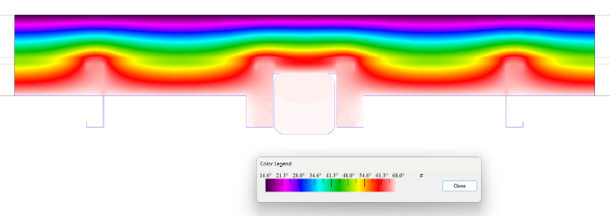
On a recent Massachusetts school project, The Green Engineer was retained to develop the required derated opaque wall U-value in accordance with Section C402.7. During our initial review, we identified a key concern: the prescriptive thermal bridge value assigned to the interior partition-to-exterior wall condition appeared significantly more conservative than the actual project detail. Rather than accepting the default prescriptive value, we recommended targeted THERM modeling to develop a project-specific Ψ-value. That recommendation proved highly impactful. Using the prescriptive approach, the project's derated opaque wall U-value was calculated at 0.089 BTU/hr-ft²-°F. Our preliminary assessment suggested that project-specific thermal analysis could reduce that result to approximately 0.070, representing a reduction of more than 20% in the reported opaque wall U-value. Subsequent THERM analysis confirmed our preliminary estimate almost exactly, yielding a final derated opaque wall U-value of 0.070 BTU/hr-ft²-°F.
The results became even more compelling when evaluating another condition. Our review identified the fenestration thermal bridge as an area where the selected reference value was likely much more conservative than the actual construction detail. Preliminary estimates showed that project-specific thermal modeling of this condition could further reduce the derated wall U-value to approximately 0.055, demonstrating additional unrealized performance potential beyond the completed scope of analysis.
For owners and design teams, the lesson is straightforward: before pursuing costly envelope redesigns, additional insulation thickness, or premium materials, it is worth evaluating whether conservative default thermal bridge assumptions are driving the results. The cost of targeted THERM analysis is typically negligible compared to the material, labor, and coordination costs associated with redesigning wall assemblies to achieve an equivalent reduction in calculated U-value. A few hours of modeling can sometimes deliver performance improvements on paper that would otherwise require significant construction expenditures.
As thermal bridge requirements become more prominent in Massachusetts energy code compliance, The Green Engineer believes that project-specific THERM analysis represents one of the highest-value opportunities available to design teams. When prescriptive Ψ-values do not accurately represent actual construction details, advanced thermal modeling can reveal performance already inherent in the design, helping projects demonstrate compliance without unnecessary cost or compromise. That's exactly what happened on this project: a recommendation made during our initial review was later validated almost perfectly through detailed analysis, yielding a substantially improved wall U-value while preserving the original design intent.
Bottom line: Before adding insulation, changing assemblies, or accepting a conservative derated U-value, consider whether project-specific THERM modeling can unlock the performance already designed into your building.
Curious what your thermal bridge details are really worth? Book a complimentary 1-hr session with our team. Book your session→
